
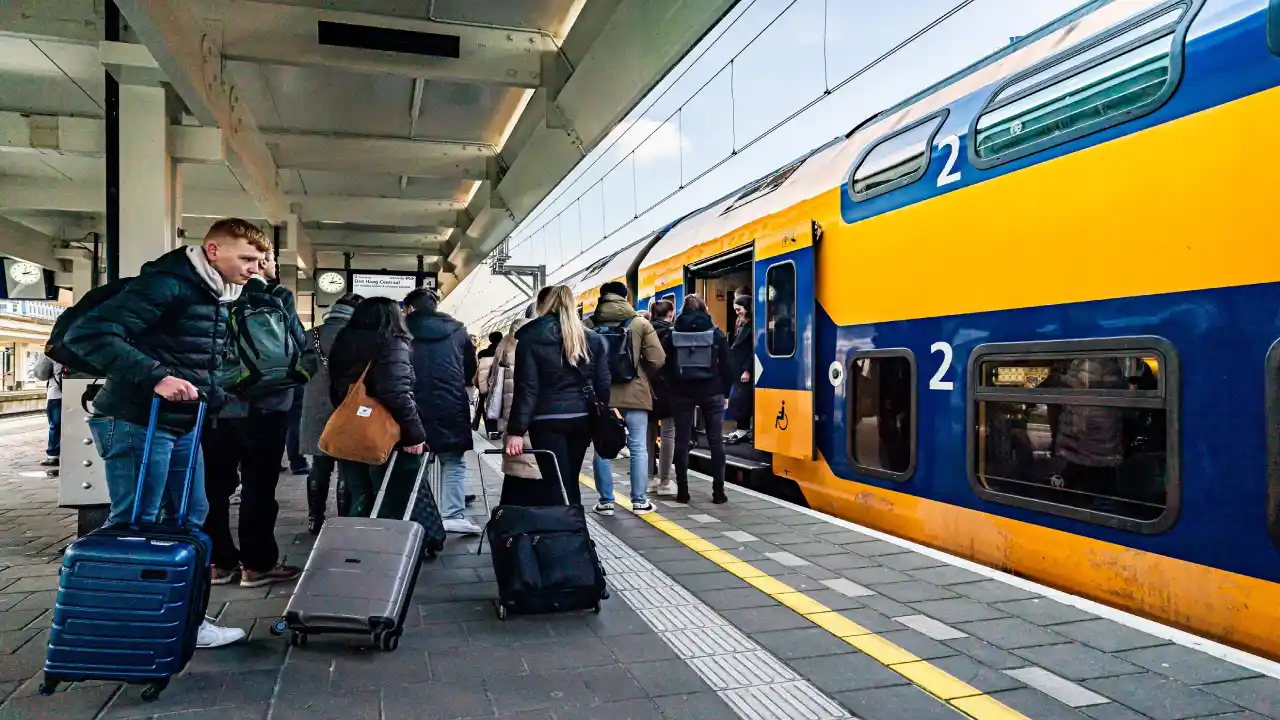
The best luggage for Europe train travel for a 4-week trip, where passengers will use flights and trains combined, is a one carry-on size rolling suitcase along with one small backpack.
The combination is highly recommended by experienced travelers, as travel to Europe often involves moving through cobblestone streets, staircases, and narrow walkways.
Any rolling suitcase is easy to carry with a smooth walkway and always feels light, while a backpack holds essentials such as travel documents, electronics, toiletries, and other daily essentials.
Train travel in Europe is most common within cities and sometimes even across border countries. The luggage size must meet the restrictions in Europe and fit easily in luggage racks. In addition, smaller, lighter luggage helps avoid delays, extra fees, and physical stress.
Luggage Size Restrictions For Europe
Before traveling to Europe, always check the luggage size, especially for trips that include flight and train travel. European airlines, especially the low-cost carriers, have strict baggage limits, and any exceeded limit may result in extra fees.
For carry-on luggage, most European Airlines have limited the size to 55 × 35 × 20 cm, and the maximum weight must be within 10 kg. On the other hand, budget airlines like Ryanair have much stricter policies, permitting carry-on luggage up to 55 × 40 × 20 cm.
For international travel, any suitcase should have a capacity of 60–80 liters and a total weight of less than 20 kg. Passengers should choose the luggage that is best suited for frequent train changes.
In addition, the rules for luggage while navigating European train stations vary. For instance,
- Eurostar allows two large bags (up to 85 cm each) plus a small handbag.
- In France. SNCF permits two suitcases for European train travel,
- Spain’s Renfe limits the checked luggage limit to 25 kg.
Which is the best luggage for European train travel: Hard-Shell or Soft-Shell Luggage
When choosing luggage, hard-shell luggage offers better protection as it is usually composed of polycarbonate, which resists impacts and rough handling. While hard-shell is prone to scratches over time, but remains durable. This is also the ideal luggage for cobblestone streets.
On the other hand, the soft-shell luggage is more flexible and easily fits in the overhead of rack luggage train. These bags are generally easy-to-manage or maneuver suitcases and are fairly lightweight and have plenty of external pockets. It is also the best luggage for stairs and platforms, as well as for crowded trains.
Important Luggage Features for Train Travel in Europe
When traveling across Europe by train, choosing the right luggage with the right features becomes very important.
Lightweight suitcase – Many European stations have stairs and narrow aisles. In that situation, a light suitcase becomes essential. Travelers very often need to carry compact luggage for frequent train changes.
Luggage with strong wheels – Along with a lightweight suitcase, strong, smooth rolling wheels are essential for any luggage. Especially, suitcases that come with 360-degree spinner wheels that move easily through narrow train aisles and perform well on uneven surfaces like cobblestone streets.
Must have TSA-approved locks – This feature is important, especially when traveling between cities and countries. Choosing durable luggage for Europe ensures luggage remains unaffected during frequent use across trains, flights, and different travel conditions.
Best Carry-On Luggage for Europe Trains
Choosing the right carry-on luggage for European train travel is important because luggage racks have limited space, and stations often have stairs, narrow walkways.
Based on many user reviews, the best carry-on suitcases for Europe must be compact, lightweight, and easy to move while still offering enough space.
The Travelpro Platinum Elite 21” Carry-On is one of the most preferred choices among travelers. It features a 45-liter capacity, weighs 7.8 lbs, and comes with MagnaTrac self-aligning wheels, which roll smoothly through aisles and stations. This luggage is suited for packing light for Europe, especially for a 3-4 day travel itinerary, especially between cities.
For passengers looking for the most affordable luggage for European travel, the Samsonite Elevation Plus Large Softside ranks top in the fray. It weighs 9.5 lbs and features dual spinner wheels, an expandable design, and is priced around 220-250 USD.
On the other hand, the Level8 Luminous Textured is best suited for carry-on luggage for European trains as well as for flights. It weighs around 8.6 lbs and has a textured polycarbonate shell, making it the most durable choice for frequent travelers.
For travelers who prefer wheeled luggage for train stations, the Dakine Split Roller 110L suits best the fits in the overhead bins and is made of waterproof materials.
If looking for premium luggage for European trips, the TUMI Expandable 4-Wheel Carry-on is the perfect choice and comes with a 5-year warranty.
European train travel tips: For a rail journey, it is always best to aim for a carry-on bag that weighs no more than 35-40 litres. Always check the Rail baggage policies as well as the airline’s baggage guidelines.
Backpack vs Suitcase For Europe Trip
Choosing the luggage for train travel in Europe is important, especially if the itinerary includes a mix of flights, trains, and road travel.
Each option has its fair share of advantages and disadvantages.
- Firstly. A large suitcase with a small carry-on offers plenty of space but can be heavy for trains and difficult to store in overhead racks. This option creates huddles in stations that have stairs and narrow walkways.
- Secondly, a large suitcase with a small backpack can be a better option. While a backpack helps in storing a laptop and essential documents but a large luggage for train travel in Europe can be tiring to lift into trains or up stairs.
- Thirdly, carrying two travel bags for European trains, one large and one small, keeps passengers’ hands free and is useful in crowded areas. But carrying the weight for weeks can be physically overwhelming and may lead to back and shoulder pains.
- Lastly, a large backpack with a small suitcase can be a more versatile option that allows you to carry everything. A major downside for this option is load can feel uneven while moving through crowded places.
However, most experienced travelers prefer a carry-on rolling luggage for train stations combined with a backpack. This combination is flexible, agile, fits well inside the trains gives enough storage. This setup works best across trains and flights.
To sum up, the best luggage for European train travel is always a combination of a carry-on rolling suitcase along with a small backpack. This combination works best at cobblestone streets, narrow train aisles, and European low-cost airlines, which have strict baggage limits – helping you avoid extra fees.
The most important takeaway is to always prefer a lightweight suitcase for Europe. For carry-on, always aim to keep the weight of the baggage under 10 kg and make sure it meets the size limit of 55x40x20cm. On European trains, the 85 cm size rule is important to remember.
Always have a combination of hardshell and softshell luggage. Hardshell offers protection from impacts, while softshell fits more easily inside the luggage rack of the train.
FAQs
A hybrid backpack offers features such as rolling wheels and lifting modes. Its performance remains stable on rough terrains and cobblestone streets. Any hybrid suitcase with a capacity of 40-50 liters works best for a 4-week Eurotrip.
Luggage with string wheels comes with polyurethane material and is best suited for 360-degree rotation to ensure stability.
The standard suggestion is 62–70 linear inches for checked bags on German and French rail networks, while the size limit for the European rail network is 85 cm.
Hardshell luggage is most suided for wet climate conditions and is mostly preferred in northern Europe.
